A local gang leader had ruined my clothes and threatened to take the farm inherited from my father, convinced that a woman in a wheelchair could do nothing against him. His brother, the town sheriff, had a reputation for making problems disappear before they reached justice.
The hot coffee soaked through my jeans and reached the skin just above my titanium prosthetics. I did not react. Silence fell in the small café like a heavy curtain. No one moved. Customers avoided looking. In this town, everyone knew who enforced the rules.
I kept my eyes on the man who had just slammed my wheelchair into the table. On his face was that dangerous certainty: the belief that he had nothing to fear.
He finally noticed the small metal badge fixed to the frame of my wheelchair.
— You soldiers think you’re above everyone else, he said with a mocking smile.
I replied calmly:
— Take your hands off.
He burst out laughing. So did his companions.
— Or what? You’re going to stand up and stop me?
He grabbed my collar as if to pull me out of the wheelchair. My hand discreetly slid toward the knife placed near my plate. Not out of fear, out of habit.
I had served in an elite unit. I had survived war, explosions, and returning to a different life. I had not come back here to fight. I only wanted to recover what remained of my family.
Then the café door opened. Several men entered without a word. Ordinary clothes, precise movements, attentive gaze. A presence instantly recognizable.😱
But when he saw their silhouettes in the reflection of the glass, his expression changed.😱😱 For the first time in a long time, he understood he had targeted the wrong person.
👉 If you are interested in this story and want to read the continuation, please check my first comment ⤵️⤵️⤵️.
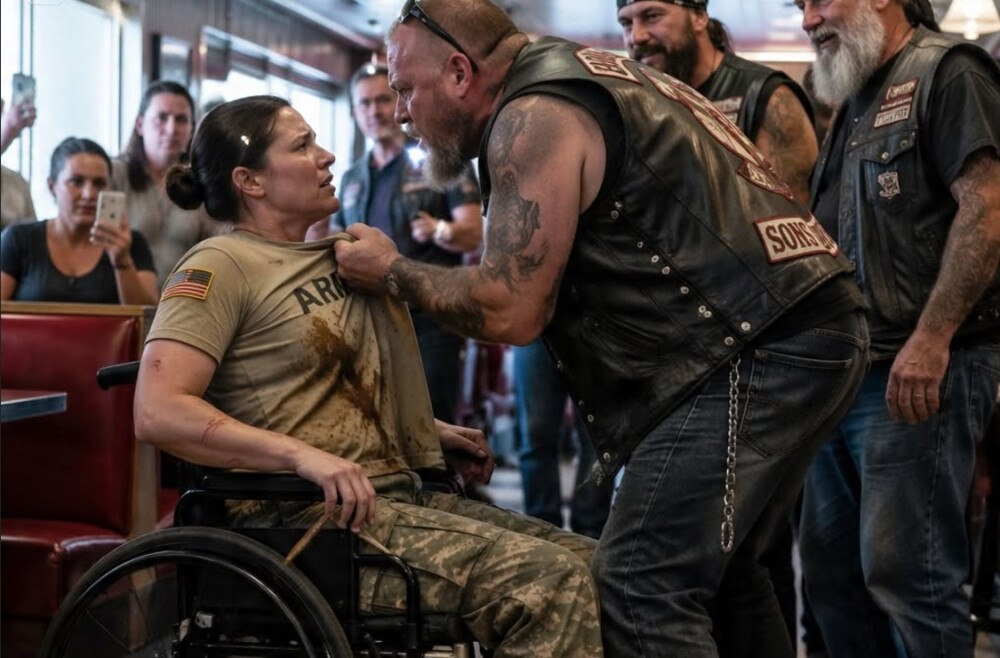
The man released his grip without taking his eyes off me. His smile had vanished. Behind him, his companions exchanged hesitant looks. The men who had entered the café still said nothing, but their mere presence was enough to change the atmosphere.
They walked forward calmly. No threat, no display of force. One of them stopped near my table and asked:
— Are you okay?
I took a napkin and wiped the coffee off my clothes.
— I’ve been through worse.
The gang leader regained a little confidence.
— This is a private matter. Get out of here.
None of the newcomers responded. Another looked at the moved wheelchair, the overturned cup, and the silent witnesses.
Then he simply said:
— Several people have been filming since the beginning.
The gang leader froze. Around us, phones gradually appeared. A waitress timidly raised hers. Then an elderly customer. Then others.
What had given them power for years was not just fear. It was silence—and that silence had been broken.
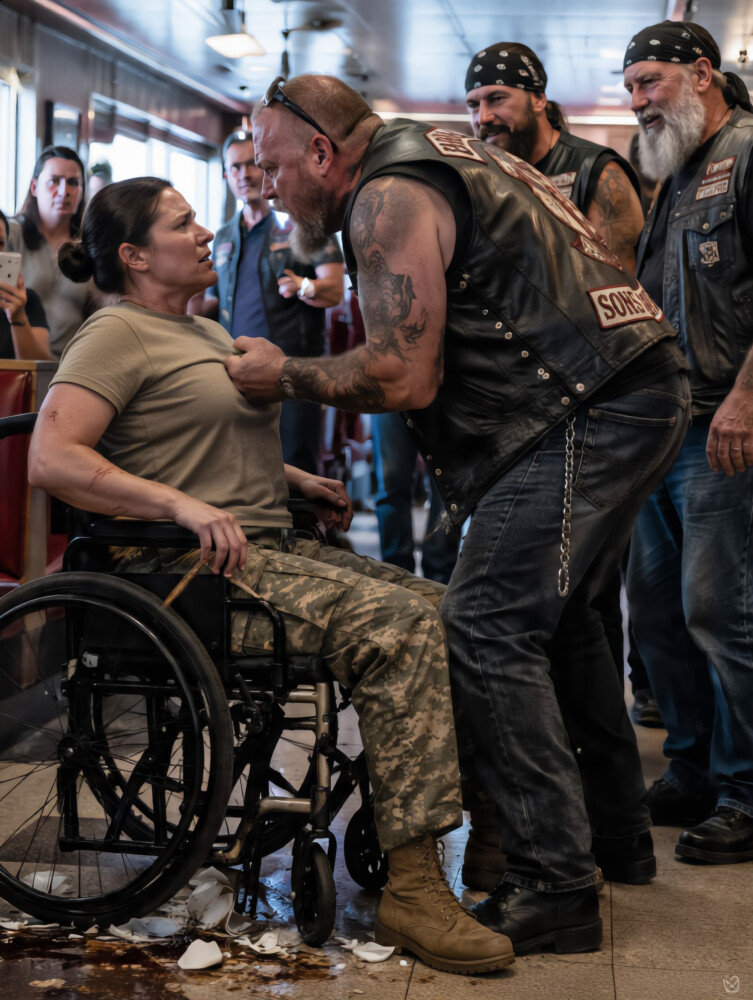
A few minutes later, the door opened again. The sheriff walked in, visibly ready to handle things as usual.
But he stopped immediately. He saw the videos. He saw the standing witnesses. He saw that no one was looking away anymore.
His brother tried to speak, but no one listened. I calmly took out the deed to the farm and placed it on the table.
— I came back to rebuild what I have left. Not to fight.
No one applauded. But that day, in that small café, something changed: for the first time in a long time, fear was no longer on the same side.