— “You are too poor to raise your daughter, love doesn’t pay the bills.” — my ex-husband’s lawyer shouted at me during the hearing. 😱😱
The courtroom smelled of old wood and worn carpet. The air was heavy, saturated with dust and old tensions.
I clenched my hands so tightly that my knuckles turned white, while the oppressive silence seemed to absorb every breath, as if the room had already witnessed too many broken families.
On the other side, my ex-husband, Julian Hayes, was impeccable in his tailored suit, every detail designed to inspire confidence. He smiled slightly, controlling the image of the responsible father everyone expected.
Beside him, his lawyer, Adrian Blackwell, walked confidently toward the judge.
— “Your Honor,” he said in a soft but firm voice, “this case is not about love. It’s about stability.”
He showed a chart of my income from two part-time jobs — one at a bookstore, the other as a housekeeper.
— “Love,” he repeated, “does not pay the bills.”
The judge nodded, and my heart sank. Adrian listed my nonexistent savings, the absence of a car in my name, while praising Julian’s stable salary, his mortgage, and his security.
Then he said my daughter’s name as if it were just another file: Amelia Hayes. Seven years old. Seven years of drawings, laughter, scraped knees, and evenings spent telling stories. Seven years in which she had been my entire world.
Adrian closed his file.
— “Your Honor, this case is about stability. Love doesn’t pay the bills.”
That’s when Amelia stood up, trembling, holding a thick envelope.
— “Mom…” she whispered.
— “Sit down, Amelia,” I whispered, terrified.
But she shook her head.
— “The judge needs to see this.”
At that moment, she asked the judge for permission to hand him something, and he agreed. And what she revealed shocked everyone. 😱😱😱
👉 To read the FULL story and see what happens next, check the article in the first comment 👇👇․
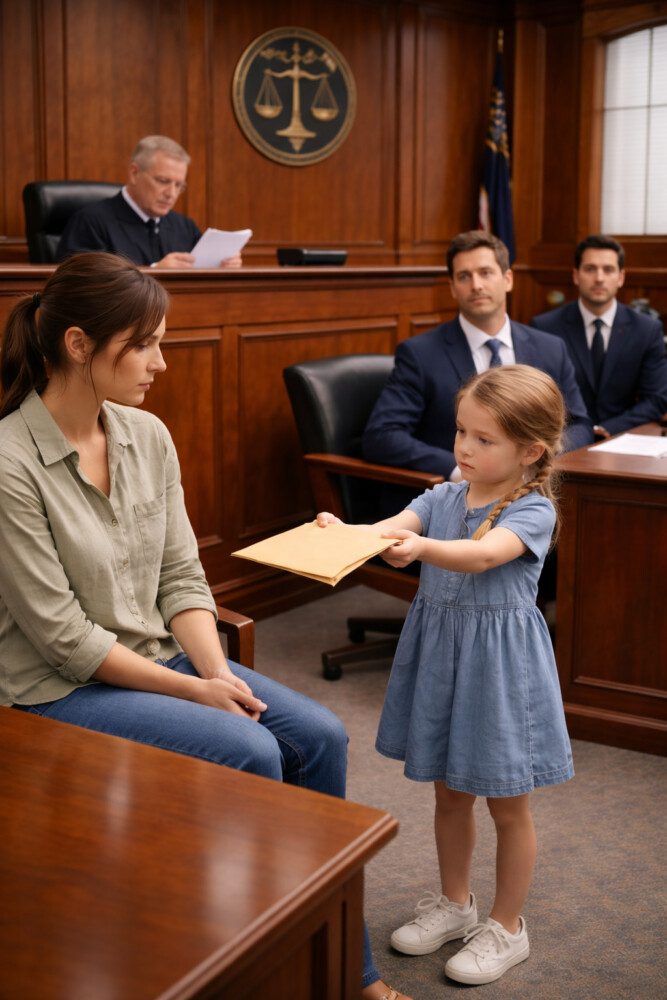
Amelia slowly stepped forward, her small trembling hands holding the envelope like a fragile treasure. The judge took it gently and opened it, under the tense gaze of the entire courtroom.
Inside, he found neither legal documents nor financial evidence, but a series of carefully folded drawings. On each, Amelia had depicted her life with her mother: our evenings reading, our simple but joyful meals, the hugs before bedtime. On the back, childlike writing accompanied each picture: “Here I am happy,” “Mom protects me,” “We laugh every day.”
But that wasn’t all.
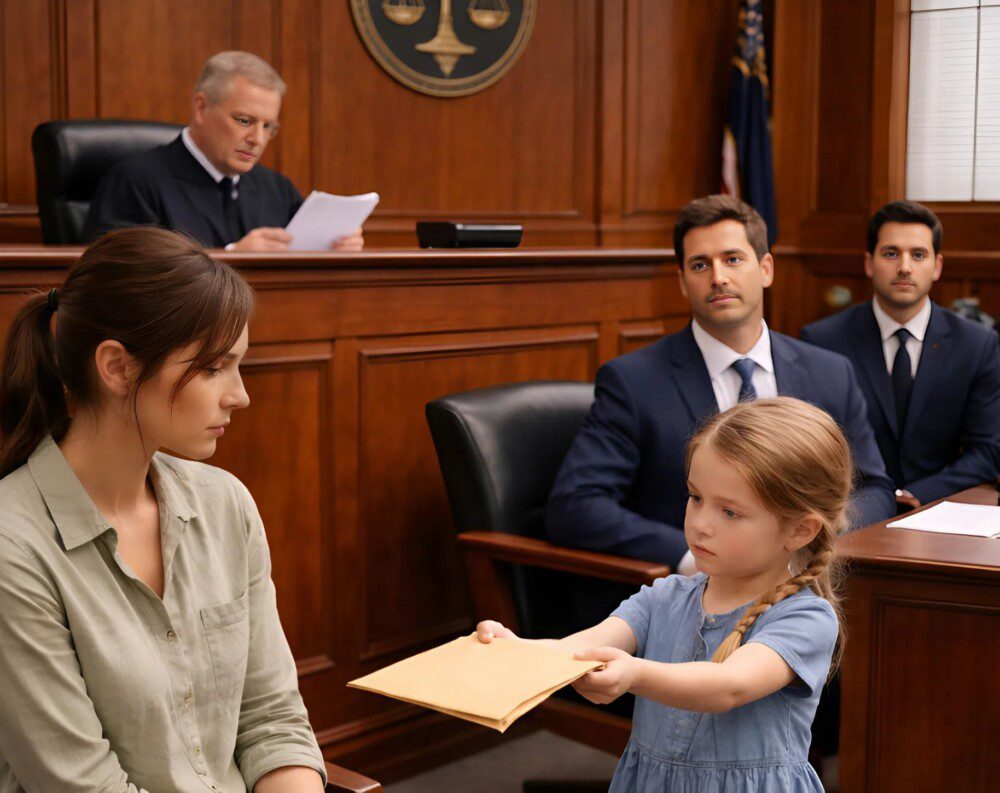
Slipped between the pages was a small notebook. The judge opened it and discovered that it was a journal kept by Amelia. She wrote about her visits to her father: the long hours alone, different nannies each week, the cold silence of a large house without warmth.
The courtroom went still.
The judge looked up, deeply moved.
— “Stability cannot be measured by money alone,” he said calmly.
The verdict came shortly after: Amelia would stay with her mother.
And for the first time in a long time, I breathed.