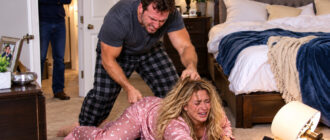
I caught my mother-in-law, Victoria, rummaging through my grandfather’s papers to find the deed to my lakeside house. Moments later, she pushed me down the basement stairs.
When my husband Julian found me injured at the bottom of the stairs, he didn’t ask if I was okay. He leaned over me and simply said:
— You should have given it to her.
The basement light swung above me as I struggled to catch my breath. Victoria calmly explained that I had simply tripped. Julian even took my phone and asked me to confirm their story, claiming that his mother only wanted to retrieve the deed to “settle the property title.”
My grandfather Arthur had left me this house as his final gift. For months, Julian had pressured me to sell it to save his struggling restaurant, while Victoria claimed she deserved a quiet place to live. I had refused.
Julian waited nearly an hour before calling an ambulance. At the hospital, doctors found a broken wrist, fractured ribs, a severe ankle injury, and numerous bruises.
I repeated their story until the nurse, Maya, asked me to stay alone. Then I grabbed her sleeve and whispered:
— Photograph everything, then call Eleanor Hayes.
Eleanor was Arthur’s estate attorney, but also the independent trustee of the Arthur Sterling Property Trust.
Two weeks later, Julian filed for divorce and moved into the lakeside house with Victoria using my stolen key. They even posted photos of their “new beginning.”
I sent one of them to Eleanor. She called me immediately.
— Do you remember Section Fourteen?
I said no.
— Your grandfather added a clause after your first engagement. The house was never yours in the sense that you could freely transfer it… and your husband has just triggered that clause.
↪️ The continuation is in the first comment. 👇👇 ⤵️⤵️

Eleanor explained that Section Fourteen had been designed specifically to protect the house from a self-interested spouse.
— If your husband attempts to sell, transfer, or occupy the property without your consent, the trust automatically takes control of the property again.
I remained silent.
— But there’s more, she added. Your grandfather anticipated what would happen if someone tried to force you to give up your rights.
My heart almost stopped.
Eleanor then sent me a copy of the document signed by Arthur. One sentence was underlined:
“Any attempt at coercion, fraud, or violence against my granddaughter will result in the immediate revocation of the responsible party’s rights and the referral of the matter to the appropriate authorities.”
I understood why Arthur had insisted that I keep Eleanor as my attorney.
Meanwhile, Julian and Victoria had already contacted a real estate agent to sell the house.

They had no idea that every conversation was now being legally monitored.
A few days later, the police knocked on their door.
Victoria was arrested for assault and trespassing. Julian, meanwhile, had to answer for aiding and abetting and fraud.
The house remained protected by the trust.
And when I finally returned to the lake, I found one last letter from Arthur.
“I knew that one day someone would try to take away what belongs to you. Never let anyone convince you that you must give up what I built for you.”