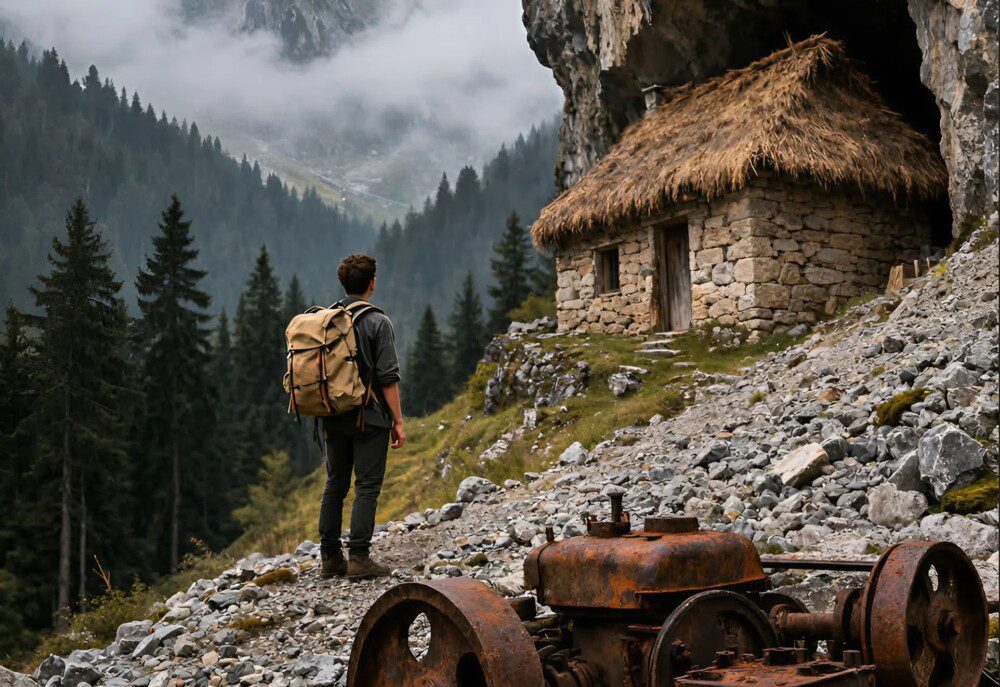
He suddenly received a letter from the notary and discovered that he had inherited a house. Thinking it was a luxurious apartment in the city, he hurried to find it. But what he discovered far exceeded all his expectations.😱😱
When Maël received the letter from the notary, he first thought it was a mistake. He had almost no family left, only vague memories of a solitary great-uncle whom no one ever spoke about. Yet the document was official: he had just inherited a house nestled somewhere in the mountains, an isolated place whose existence he had never even known.
A few days later, driven by curiosity mixed with apprehension, he set out on the journey. The road quickly became narrow, then almost disappeared entirely, replaced by a rocky path winding between pine trees and mist. After several hours of walking, the silence became so deep that he could hear only his own footsteps and the wind striking the cliffs.
Then he saw it — the house… 😱 It seemed literally embedded in the rock, as if the mountain itself had swallowed it before spitting it back out. A small thatched roof, stone walls worn by time, and all around, nothing but cliffs and a valley drowned in fog. In front of the entrance lay an old rusted machine, abandoned for decades, a silent witness to a forgotten past.
Maël stood still, stunned. How could anyone have lived here? Why had his great-uncle chosen such an inaccessible place? A strange feeling came over him, a mixture of wonder and unease.
The door creaked as he pushed it open. The most shocking thing was what he found inside the house.😱😱😱
↪️ The continuation in the first comment. 👇👇
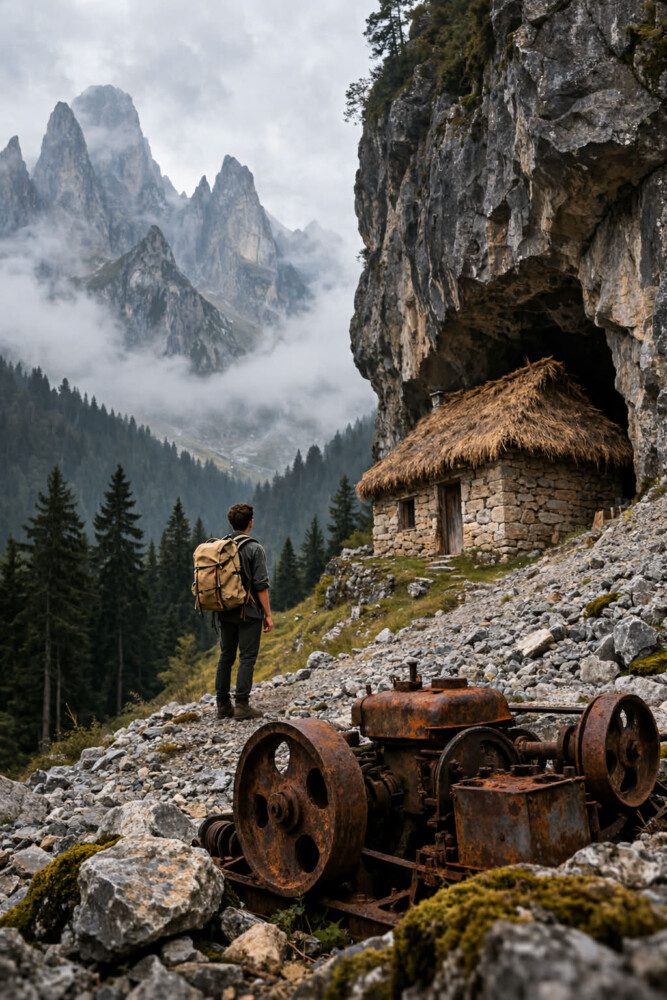
As he entered, Maël expected to discover an abandoned house, covered in dust and overtaken by time. Yet the interior was surprisingly orderly. A faint smell of wood and dried herbs still lingered in the air, as if someone had lived there recently.
On the central table lay carefully arranged objects: an oil lamp, leather-bound notebooks, and a pair of old glasses.
Intrigued, he opened one of the notebooks. It was not an ordinary personal diary, but a precise record. His great-uncle had noted each day the weather, the movements of the mountain, nighttime sounds, and even small tremors felt beneath the ground. Some pages contained detailed sketches of cracks in the rock and dates circled in red.

Further on, Maël discovered a room locked with a key. After several attempts, the lock gave way. Inside was simple yet real equipment: old measuring instruments, a barometer, a portable seismograph, and geological maps covering the entire region. His great-uncle was not a mad hermit… but a man who monitored the mountain.
At the bottom of a drawer, he found a letter addressed to him. It explained that the area was unstable and that the house served as a discreet observation post to warn of landslides. Suddenly, Maël understood: this inheritance was not a house… but an unfinished mission.