Separated after 14 hours of surgery: the medical battle that gave a new life to two conjoined twins.
Two Pakistani twin girls, only 11 months old, were successfully separated after an exceptional 14-hour surgical procedure, conducted jointly by British and Turkish medical teams. The doctors are very optimistic about their full recovery.
Minal and Mirha were born with an extremely rare malformation: their skulls were fused, and they shared several vital blood vessels. 😱 A condition known as craniopagus, which makes any attempt at separation particularly risky. Yet, thanks to meticulous preparation and exemplary international collaboration, the two girls now have the opportunity to live their own individual lives.
The procedure was coordinated by a humanitarian organization specialized in the care of craniopagus twins. At the head of the team was a world-renowned British pediatric neurosurgeon, recognized for his expertise in this extremely complex type of surgery.
They faced several difficulties, but the operation was successful.
👉 Let’s look at the photos after the separation and already grown at the link in the first comment👇👇👇👇.
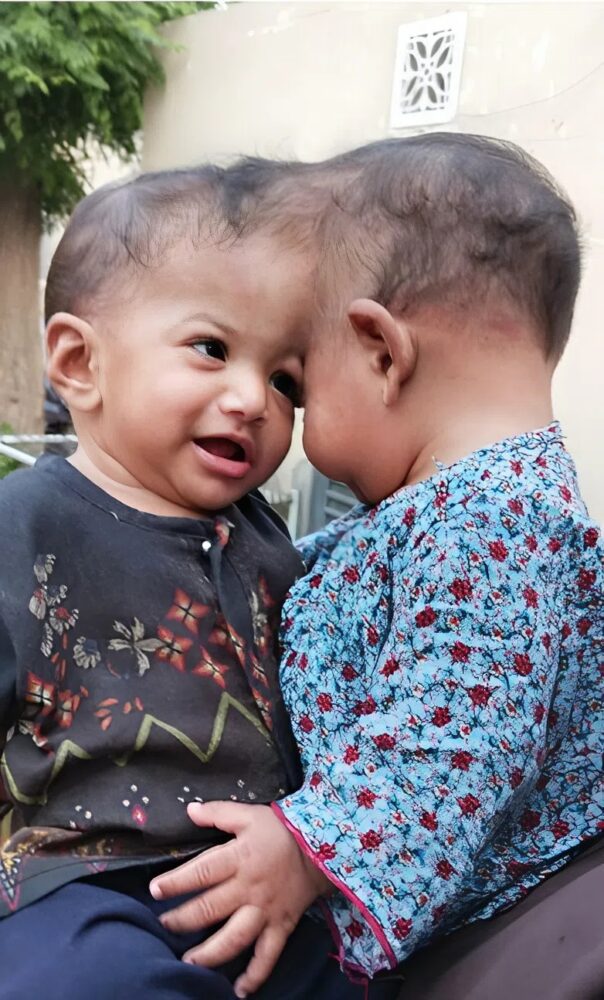
The separation took place in two distinct phases. In the first phase, the doctors performed gradual expansion of the scalp tissues using devices implanted under the skin. This step, carried out over several weeks, was essential to generate enough tissue to protect the brain after the separation.
Even before entering the operating room, the surgeons extensively rehearsed every move using advanced technologies: three-dimensional scans and virtual reality simulations allowed them to anticipate every difficulty.
The final phase of the operation took place on July 19 at Bilkent City Hospital in Ankara. More than 60 specialists — neurosurgeons, anesthetists, reconstructive surgeons, and nurses — worked tirelessly for 14 hours to successfully carry out this delicate separation.
“When we realized the operation was successful, the entire team spontaneously applauded. It was a moment of incredible intensity,” said one of the surgeons involved. Today, both babies are gradually recovering under close medical supervision.

The first days after the separation were emotionally challenging for the twins, who were used to being constantly together. The doctors therefore chose to keep them in the same room to facilitate this transition. Gradually, they adapted, and their progress is considered very positive.
Their parents, deeply moved, expressed their gratitude to the medical teams and volunteers involved in this extraordinary human journey. For them, this operation represents much more than a surgical achievement: it is a second birth for their daughters.
For Dr. Jeelani, this success illustrates what modern medicine can accomplish when borders disappear: “When children need help, the whole world can mobilize — and offer hope where it seemed impossible.”